
[Infographic] Samsung PM1763 SSD: A Core Storage Solution for Next-Generation AI Platforms


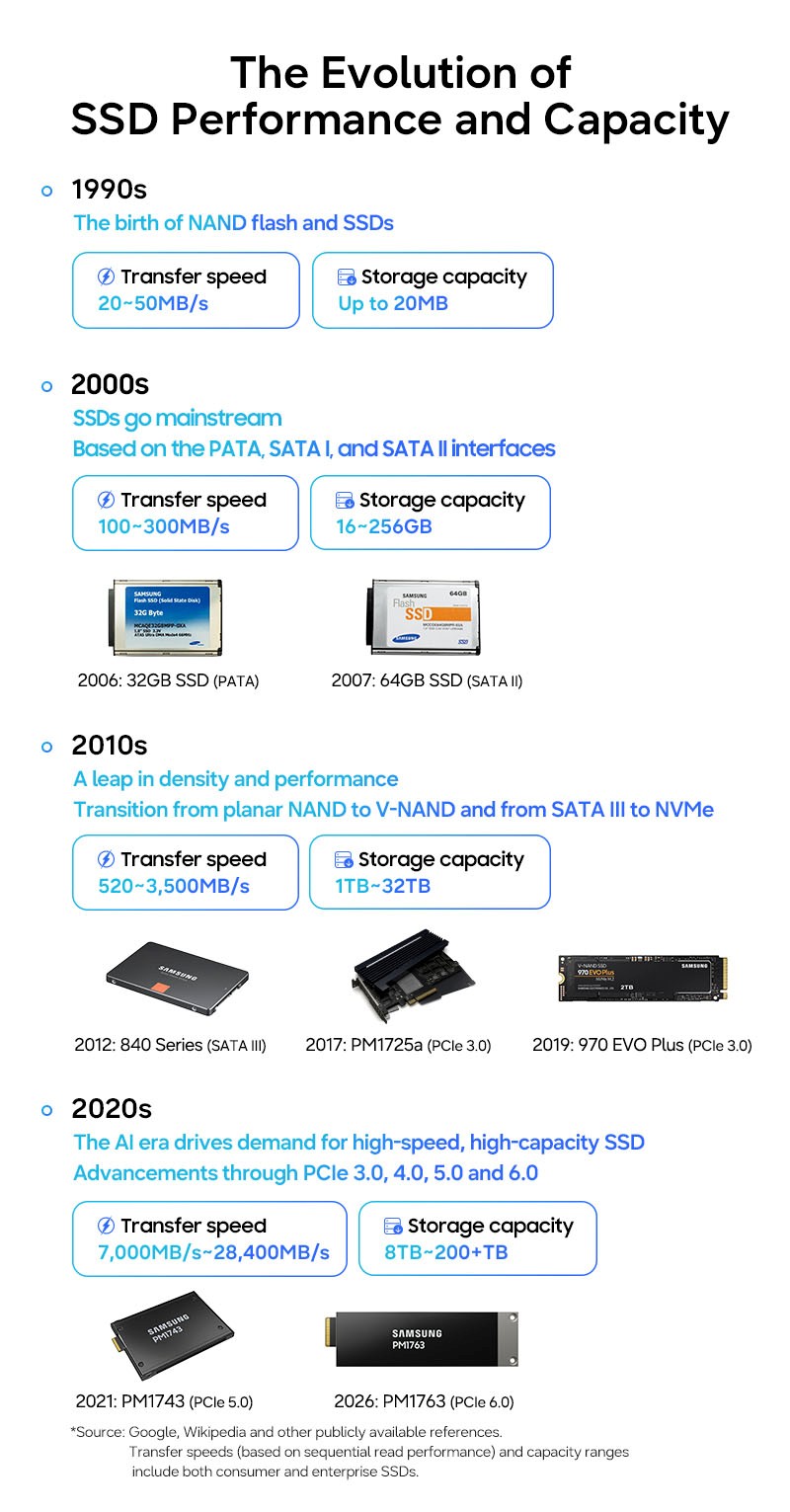
When Solid State Drives (SSDs) first gained widespread adoption in the 2000s, they quickly replaced Hard Disk Drives (HDDs) as the standard storage solution for PCs. Compared with HDDs, SSDs offered significantly faster read and write speeds, lower noise and heat generation, and greater durability against physical shock.
As NAND flash and controller technologies evolved and interfaces advanced from SATA to NVMe, SSD performance improved dramatically. Storage capacity also expanded from gigabytes to tens of terabytes to keep pace with the rapid growth of digital data.
Today, rapid advances in AI, particularly in large language models (LLMs) and deep learning, have transformed SSDs into a critical component of AI infrastructure. As AI applications become increasingly sophisticated, high-performance storage has become more important than ever.
* Large language models (LLMs) are AI models trained on massive datasets that can understand human language and perform tasks such as generating text, translating languages, and creating images and videos.
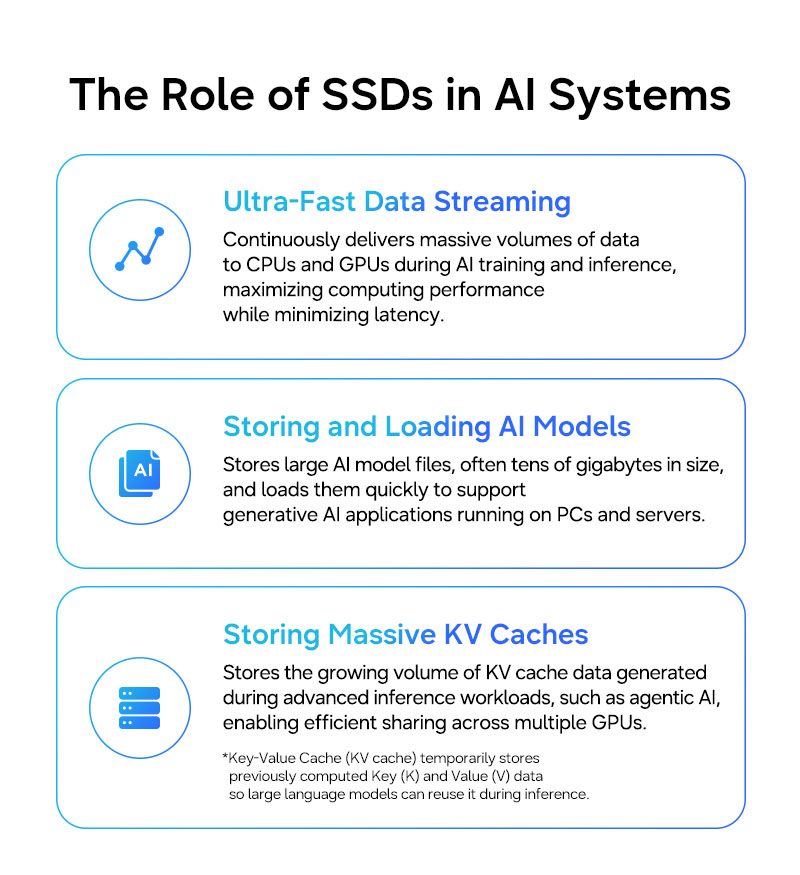
What Role Does an SSD Play in AI Systems?
Today, generative AI makes it easy to edit photos and videos, create content, and even handle tasks such as writing documents and coding. As AI becomes an integral part of everyday life, the volume of data being generated is growing at an unprecedented pace.
AI systems must process massive amounts of raw data to train AI models. Once trained, these models perform inference by analyzing large-scale datasets in real time to generate insights and respond to users’ requests.
So, what role do SSDs play in making all of this possible?
PM1763: The SSD Optimized for Next-Generation AI Platforms
AI SSDs must deliver data fast enough to keep pace with the processing speeds of GPUs, CPUs and AI accelerators. By minimizing data bottlenecks, they maximize the performance of AI training and inference. As AI systems process ever-growing volumes of data, storage performance has become more critical than ever, since response time directly impacts the quality of AI services.
Against this backdrop, Samsung’s PM1763 is poised to become a core storage solution for next-generation AI platforms. It delivers outstanding performance with one of the industry’s fastest sequential read speeds, an optimized controller architecture for highly efficient data processing and significantly improved power efficiency. Supporting the latest NVMe 2.1 standard, the PM1763 also enables smarter data management in AI and virtualized server environments.
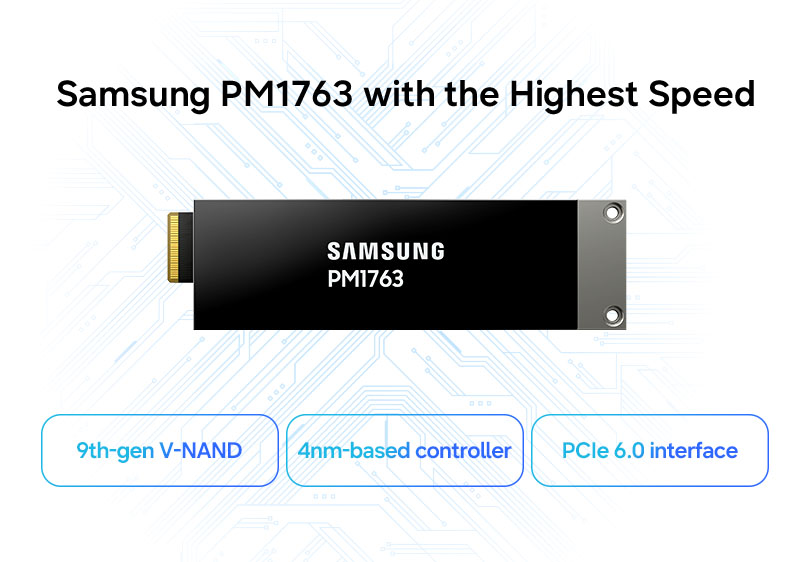
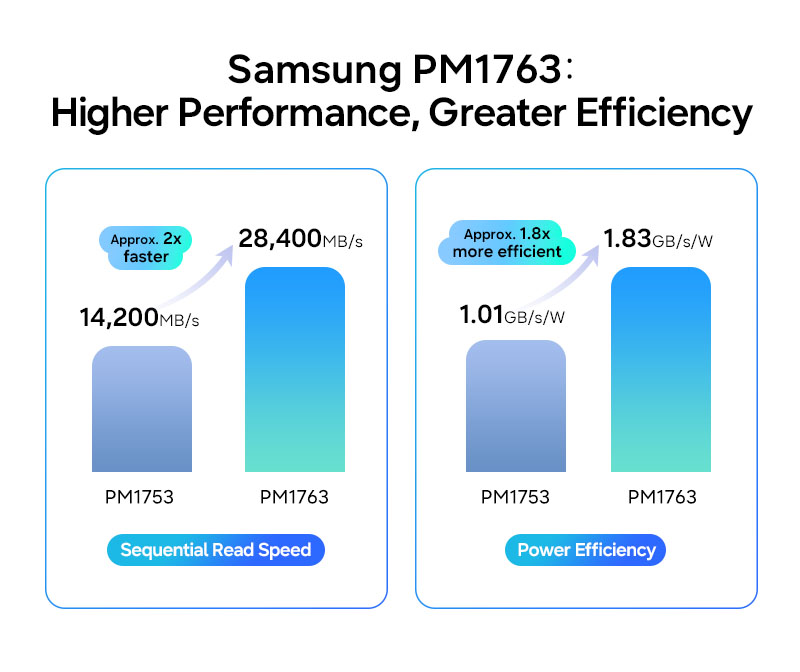
The PM1763 delivers industry-leading performance. The flagship 16TB E1.S model, the highest-capacity option in the lineup, offers sequential read speeds of up to 28,400 MB/s and sequential write speeds of up to 21,900 MB/s, more than 2 times faster than its predecessor. Many of today’s widely used LLM models are around a 40 GB in size, meaning the PM1763 can transfer one in approximately 1.4 seconds. The PM1763 also delivers more than 1.8 times higher power efficiency than the previous generation, helping data centers reduce operating costs while improving overall energy efficiency.
The PM1763 is available in 4TB, 8TB and 16TB capacities, providing the flexibility to meet a wide range of AI server and data center requirements. As storage needs vary depending on workload size and system configuration, these capacity options enable more efficient infrastructure planning. Designed for next-generation AI platforms that must rapidly load and process massive AI models and datasets, the PM1763 delivers the high-speed performance and stable storage operation needed to support demanding AI workloads.
The PM1763 is also optimized for the liquid-cooled environments used in next-generation AI servers. Designed for Direct-to-Chip (D2C) liquid cooling, which attaches a cold plate directly to the device, it maintains peak performance over extended periods, even under the intense heat generated by high-performance AI workloads.
Security has also been significantly enhanced to meet the growing demands of AI applications. The PM1763 incorporates post-quantum cryptography (PQC) to help protect data against future quantum computing threats, while TDISP technology helps secure data transmission paths in virtualized environments, enhancing overall system security.
PM1763: An Industry-Leading AI Storage Solution
Recognized for its technological innovation, the PM1763 SSD received the Best of Show Award in the Most Innovative Memory Technology category at FMS 2025, one of the world’s largest memory and storage technology exhibitions. The award recognizes the PM1763 as a high-performance enterprise SSD designed to accelerate AI infrastructure innovation.
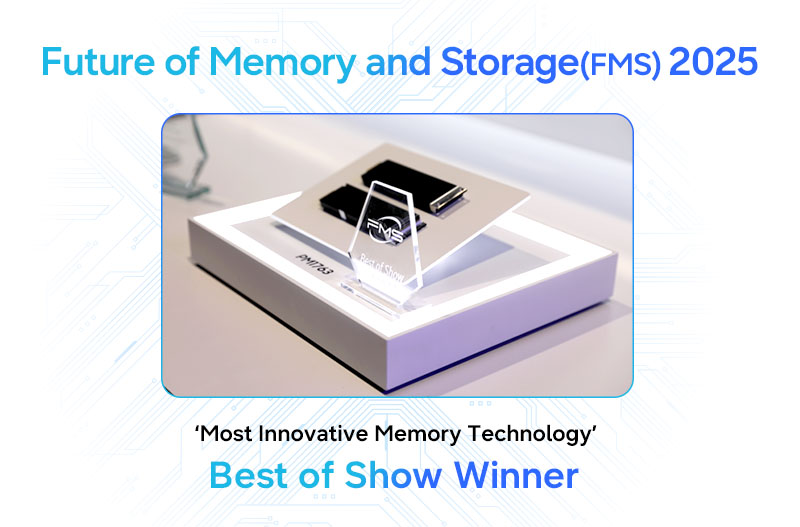
As a global leader in memory technology, Samsung Semiconductor will continue to introduce next-generation memory and storage solutions, including the PM1763, to help drive AI infrastructure innovation.
Related tag
Related Stories
-
 2026.08.05[Infographic] The Evolution of AI-Era Memory: Faster, Denser Computing
 -
 2026.07.03[Infographic] Teamwork Behind Cutting-Edge Chip Manufacturing: How Samsung Foundry's SAFE™ Ecosystem Powers Next-Generation Semiconductor Innovation
 -
 2026.06.23[Infographic] UFS 5.0 Memory: The Optimal Solution for On-Device AI