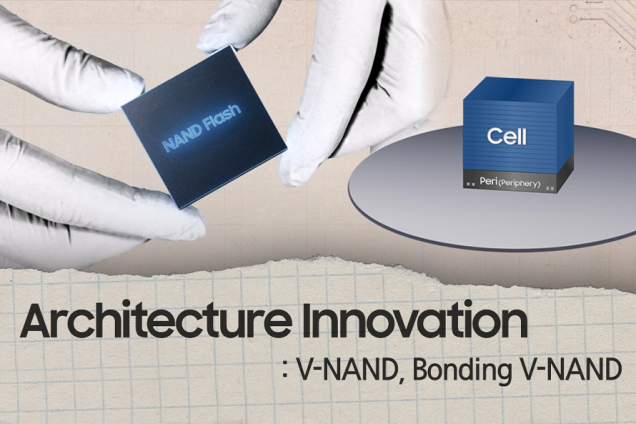
[Video] The World of Nano – From HBM to zHBM: Rethinking Architecture Innovation


Advancing Memory Architecture for the AI Era – Up to 8x Performance Gains
As AI computational demands continue to grow, data bottlenecks have become increasingly critical. Traditional planar memory architectures are under growing pressure to deliver the bandwidth and power efficiency needed to move massive amounts of data.
Samsung addresses this challenge through vertical stacking architecture. Beginning with High Bandwidth Memory (HBM), this innovation leverages Through-Silicon Via (TSV) technology to create thousands of vertical data pathways, dramatically reducing data travel distances.
Beyond HBM: Why zHBM?
While HBM represented a major breakthrough, conventional HBM placed memory alongside the AI accelerator in a side-by-side arrangement, requiring data to travel complex paths through logic chips, interposers, and back to memory. This leaves room to further reduce data travel distance and improve power efficiency.
zHBM revolutionizes this approach by stacking HBM directly on top of AI accelerators, eliminating intermediate routing and creating the most direct data pathways possible.
Discover how HBM’s technical principles and zHBM’s innovations are transforming the future of AI computing.
This breakthrough represents the integration of Samsung’s memory technology, foundry processes, and advanced packaging capabilities. It’s a critical solution for solving AI-era data bottlenecks and maximizing data center efficiency.