
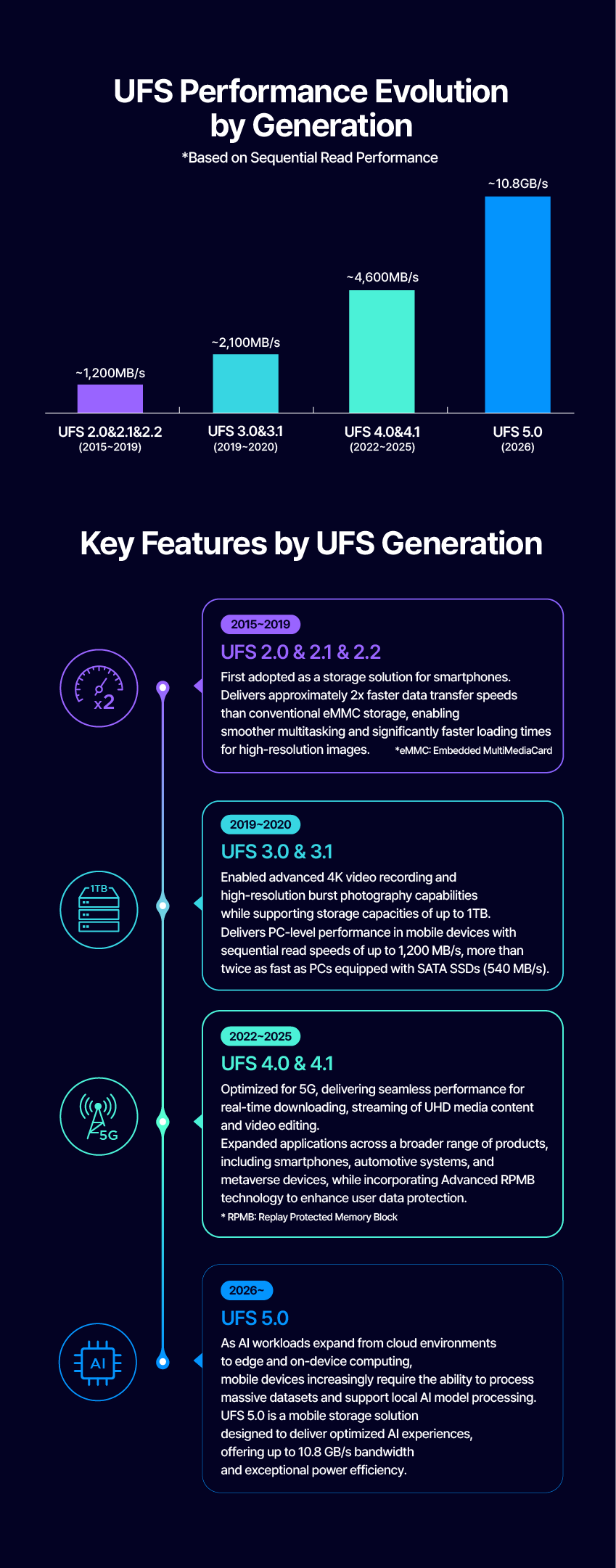
[Infographic] UFS 5.0 Memory: The Optimal Solution for On-Device AI


Samsung Electronics has announced the development of its next-generation Universal Flash Storage (UFS) 5.0 mobile memory solution, setting a new benchmark for performance in the industry. UFS is the standard specification for embedded flash memory, and Samsung’s latest UFS 5.0 solution is expected to serve as the primary storage solution for a wide range of mobile devices, including next-generation smartphones.
On-device AI is driving the latest smartphone trends. By processing data locally rather than relying on cloud servers, devices can seamlessly support features such as real-time translation and advanced photo editing. Handling these workloads directly on the device requires the ability to process vast amounts of data locally, making advanced semiconductors like APs, including NPU, as well as RAM more important than ever.
Among these components, UFS does more than simply store high-resolution 4K/8K videos, images, and applications. It also serves as a critical enabler of on-device AI by swiftly delivering AI models and data to RAM, allowing the AP to perform AI computations efficiently.
Since the commercialization of UFS 2.0, Samsung’s UFS memory solutions have been widely adopted in mobile devices for more than a decade, helping securely store users’ valuable data. Today, UFS 5.0 delivers an optimized solution for the on-device AI era, offering data transfer bandwidth of up to 10.8 GB/s.
Explore the infographic below to see how Samsung UFS has evolved across generations and the key innovations that have helped shape the future of mobile storage.
By running AI models directly on edge devices rather than relying on the cloud, on-device AI enables data to be processed locally. To better understand how this works, let’s look at a simple example that highlights the roles of UFS and other key semiconductor components.
Imagine a smartphone user editing a high-resolution video using an AI-powered feature.
Step 1: When the user launches the AI feature, the AP instructs the UFS storage to retrieve the required AI model, such as generative AI or multimodal model, along with the video data.
Step 2: The UFS storage reads the model and data and transfers them to RAM.
Step 3: Using the AI model and data stored in RAM, the AP perform AI inference to complete the editing task.
In step 2, speed is critical. The UFS must rapidly read and transfer the AI model and original video data into RAM. With a bandwidth of up to 10.8 GB/s, UFS 5.0 can load ultra-high-definition 4K video files, often tens of gigabytes in size, into memory within seconds. This enables users to complete AI-powered tasks quickly and seamlessly.
This infographic highlights the generational evolution of Samsung’s UFS memory solutions, mapping out key advancements alongside a practical look at how UFS empowers on-device AI. Moving forward, Samsung Electronics will continue to introduce advanced memory solutions like UFS 5.0 to meet the growing demands of the AI era.
Related tag
Related Stories
-
 2026.07.03[Infographic] Teamwork Behind Cutting-Edge Chip Manufacturing: How Samsung Foundry's SAFE™ Ecosystem Powers Next-Generation Semiconductor Innovation
 -
 2026.06.17Breaking Through the Limits of Horizontal Scaling with Vertical Innovation
 -
 2026.04.30Samsung Foundry 4nm FinFET: The Best of Both Worlds for Performance and Reliability